The Importance of Balance after 50 After 50 - Why It Matters and How to Improve It
The Importance of Balance After 50
Why It Matters and How to Improve It
By Jo Ann Goodie-Charles, RN, CPT
As we age, maintaining our independence becomes one of the most valuable aspects of living well. While many people focus on weight loss or general fitness, one of the most critical yet overlooked aspects of healthy aging is balance.
Balance is the quiet guardian of independence. It allows us to walk confidently, climb stairs, step over obstacles, and move through our daily lives safely.
After the age of 50, however, natural changes begin to occur in the body that can affect balance. The good news is that balance can be improved and maintained with intentional movement and strength training.
Why Balance Declines as We Age
Balance is not controlled by one single system in the body. It is the result of several systems working together:
Muscles
Joints
Vision
Inner ear (vestibular system)
Nervous system response
As we age, several changes occur that can impact these systems.
Loss of Muscle Mass
Beginning around age 30, we gradually lose muscle mass, and the process accelerates after 50. This age-related muscle loss, known as sarcopenia, reduces strength in the legs, hips, and core—muscles that are essential for stability and balance.
Reduced Joint Mobility
Stiff joints and reduced flexibility can make it harder for the body to react quickly when balance is challenged.
Changes in Vision
Our eyesight plays a major role in helping us stay oriented in space. Changes in depth perception and vision clarity can affect balance.
Inner Ear Changes
The inner ear helps regulate equilibrium. Aging can reduce the efficiency of this system, which may contribute to dizziness or instability.
Slower Reaction Time
As nerve signals slow with age, the body may not respond as quickly when we trip or lose balance.
Why Balance Matters So Much After 50
Balance is directly connected to fall prevention.
According to the Centers for Disease Control and Prevention (CDC):
One in four adults over the age of 65 falls each year.
Falls are a leading cause of injury among older adults.
Falls can lead to:
Fractures
Loss of mobility
Decreased confidence in movement
Reduced independence
But the story does not have to end there. The encouraging truth is that many falls are preventable with proper strength training, balance exercises, and awareness.
Signs Your Balance May Be Declining
Many people do not realize their balance is changing until they experience a fall. However, there are early warning signs.
You may notice:
Feeling unsteady when walking
Holding onto furniture when moving through the house
Difficulty stepping over objects
Trouble standing on one leg
Slower walking speed
Feeling cautious or fearful about falling
Recognizing these signs early allows you to take action before a serious fall occurs.
Exercises That Improve Balance
The encouraging news is that balance can be trained and improved at any age.
Simple exercises performed consistently can strengthen the muscles responsible for stability.
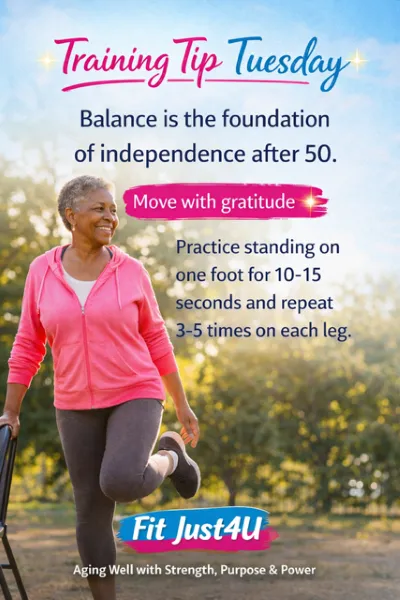
Single-Leg Stand
Stand near a chair or wall for support.
Lift one foot off the ground and hold the position for 10–15 seconds.
Repeat 3–5 times on each leg.
This exercise strengthens stabilizing muscles in the legs and core.
Heel-to-Toe Walk
Walk in a straight line placing one foot directly in front of the other, heel touching toe.
This improves coordination and body awareness.
Sit-to-Stand
Practice standing up from a chair without using your hands.
This strengthens the legs, hips, and core, which are essential for balance and mobility.
Gentle Strength Training
Strength training for the glutes, hips, thighs, and core significantly improves balance and stability.
These muscle groups act as the foundation of safe movement.
Balance Begins with Strength
Many people think balance is simply about standing on one foot. In reality, balance is built upon a foundation of strength, posture, and coordination.
Strong muscles help stabilize the body and allow us to react quickly when we lose our footing.
This is why strength training becomes increasingly important as we age.
When we maintain muscle strength, we protect our:
Mobility
Stability
Confidence in movement
Independence
A Message of Gratitude
Every step we take is something to be grateful for.
Our ability to walk, stand, move, and care for ourselves is a gift that should never be taken for granted.
Practicing exercises that improve balance is not just about preventing falls—it is about honoring the body God has given us and caring for it with intention.
With consistent movement, strength training, and awareness, we can continue to live active and fulfilling lives.
At Fit Just4U Personal Training & Wellness Center, we believe aging should be embraced with strength, wisdom, and purpose.
Because aging well is not about slowing down.
It is about moving forward with confidence and gratitude.
Fit Just4U Personal Training & Wellness Center
Aging Well with Strength, Purpose & Power